General Topics
Scene Appreciation: Emergency Meeting In “Margin Call”
In an attempt to cry and capture those scenes that stick in the mass’s minds, I am going to start jotting down the YouTube searches that constantly repeat themselves.
Movies…with a little bit of obscure culture and sports mixed in
In an attempt to cry and capture those scenes that stick in the mass’s minds, I am going to start jotting down the YouTube searches that constantly repeat themselves.
The other day I posed a question to Emma asking her what are her most watched television or movie clips? If she had someone constantly counting every media snippet she searched on her various apps, what scenes would be in her top moments.
It’s a hard question. For people who consume a lot of media, to go through and think about specific scenes that stick with you can lead to a very long list. You think you will have a list done, but then an “Oh shit, that one” moment happens.
In an attempt to cry and capture those scenes that stick in the mass’s minds, I am going to start jotting down the YouTube searches that constantly repeat themselves.
First up is a scene from Margin Call (2011).
Writer and director J.C. Chandor’s first major motion picture tackles the 2008 financial crisis from the perspective of integral employees in a high stakes trading firm. The screenplay doesn’t simplify the language of the business. Instead, it demands that the audience keep up with the tight-strung jargon and vulgarity. To Chandor’s credit, Margin Call doesn’t keep its audience on the margins. The chaos is discovered, and then diagnosed, and it’s all digestible to the viewers, whether they be economics aficionados or not.
Let’s set the scene.
Peter Sullivan (Zachary Quinto) has discovered a massive problem that was initially flagged by his laid off boss Eric Dale (Stanley Tucci). Stanley shares this scary report with his friend Seth Bregnan (Penn Badgley) and together they bring it to Will Emmerson (Paul Bettany). After an initial shock, Will steps into high gear and calls a meeting with Sam Rogers (Kevin Spacey), his long tenured boss who has grown comfortable with being paid a lot while doing very little. Rogers must spring into action and go meet with his much younger boss Jared Cohen (Simon Baker), who makes the final call to bring the head honcho. The big guy.
In a short time we have progressed through multiple levels of bureaucracy. After being propelled into the story with no seatbelt, the characters and audience are all of a sudden jolted to a stop with an emergency handbrake.
Enter John Tuld (Jeremy Irons).
This emergency meeting in Margin Call is made by one man and one man only. Jeremy Irons walks into this room and immediately dominates the screen. We get the tease with one of his assistants entering first, followed shortly after by Irons as John Tuld. The quick acknowledgement of another heavy-hitter in the room is all the pleasantries we’ll get. As Mr. Tuld would say, the foreplay to the real issues is spilt milk under the bridge.
Jared tries to approach the matter with a business-like manner but Mr. Tuld dismisses that. There is a great quick cut to Sam having a facial tick, knowing that approach isn’t going to work. Tuld wants this mess told to him in plain English. Simply. As if he knows nothing at all. Mr. Tuld has made himself like the audience; wanting everything spelled out for him so he can understand the cause and effect. He wants it black & white so he can make a decision on what to do.
“It wasn’t brains that got me here, I can assure you of that.” – this line is another example as to how the richest and most important man in the room is making himself relatable to not only Mr. Sullivan, but again, the viewer.
The first time we don’t see Mr. Tuld’s face while he is speaking is when Sullivan is explaining that this leverage the company has found itself under has already been building for two weeks. They aren’t being proactive, even if they wanted to. This is a reactive meeting, and when reacting to a crisis one needs a plan. But when the problem is unprecedented, finding an ideal plan on a deadline is near impossible.
Tuld rises from his chair when he believes that he has a grasp on the damage this situation can cause. This is where credit must be paid to Irons and film editors and Irons. The cut to Tuld with his head raising up as he says “capitalism” is sneaky and profound. That action by Tuld tells the viewer that he is not afraid to look a shitstorm down the barrel. Tuld said he is not the smartest in the room, but he gets paid to make hard decisions, and it’s safe to say that this financial institution is in a massive hole of shit.
The stank look that Jeremy Irons has when the camera cuts back to him sitting down in the chair is just so good. There isn’t a need to complicate it. The hand on his face. He is smelling the shitstorm that he is in, and he knows that he has to find a way out of it no matter how much it offends his nostrils.
Now it’s truly time to cook.
Tuld is back standing up talking about what he does. His job is to predict what the music, AKA the market, is going to do. The reason he is paid the big bucks to make those decisions.
One of the coolest little tid-bits from this scene I love is nothing verbal. It’s all about camera angles and actor placement. Whenever Jeremy Irons is sitting in his chair, he tends to lean to the left. There is always a bit of empty space to his right. Then when he goes up to the window the first time, the New York skyline is dark and it is to his right. Again, dead space. Cut now to this moment, when Tuld says he doesn’t hear any music. The camera angle is slightly closer, and the emptiness next to Tuld on the right-hand side is even more profound.
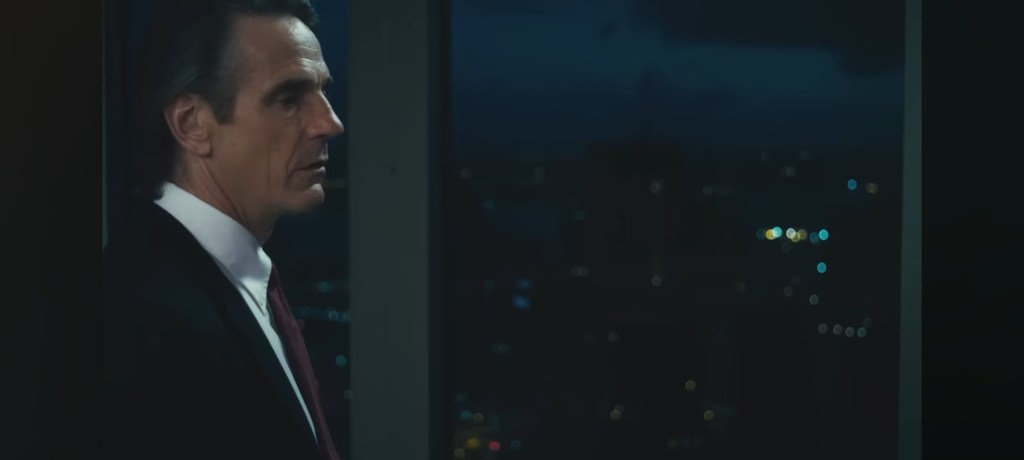
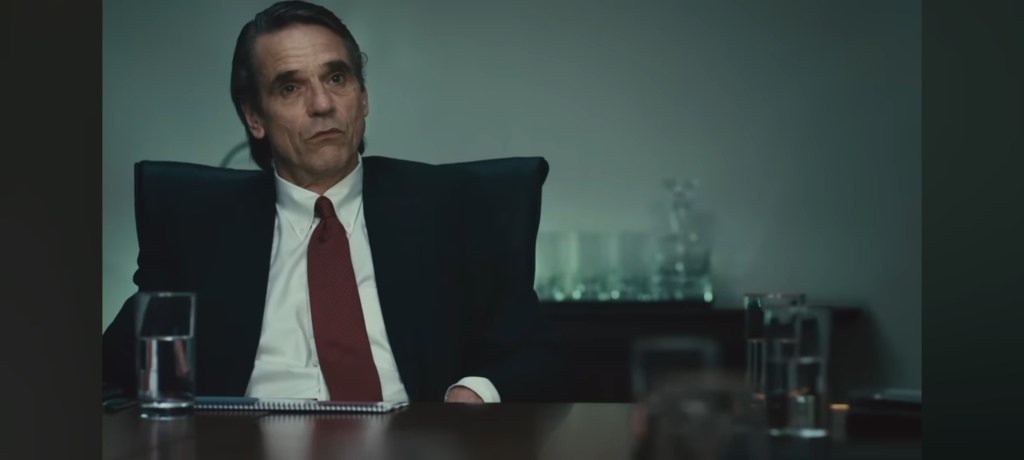
After Tuld says he hears nothing, the silence in the room is deafening. Everyone knows he is right, and everyone knows that there is nothing they can say at this moment. Tuld lets them sit in it for a while before turning to Mr. Cohen and asking him what they can do about the fiscal disaster that’s ahead of them.
The man in the high chair turns his attention to the left now, and Chandor moves the empty space. The emptiness on the left now signifies that we are in a new part of this conversation. It’s no longer about what is happening. It’s about what needs to happen next.
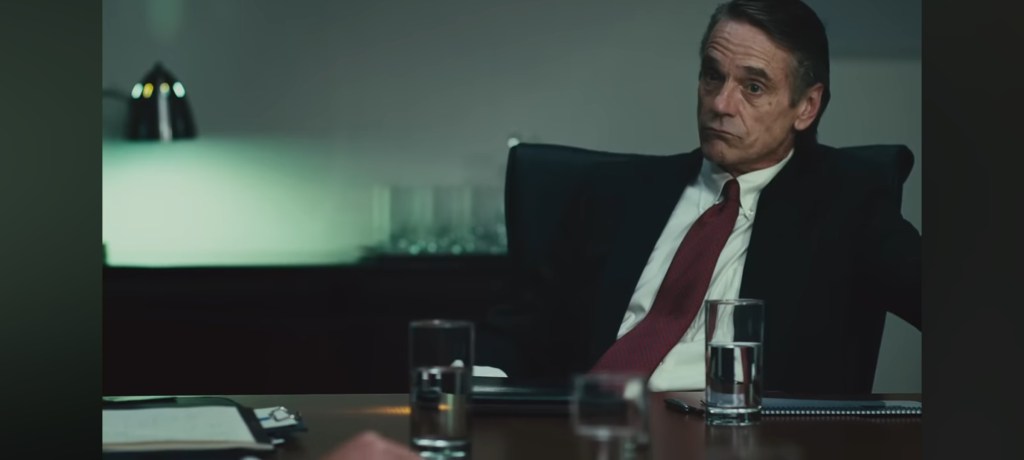
Tuld knows what has to be done, but he needs to hear the others say. He talks with Cohen and asks him what he told him when he started..
“There are three ways to make a living in this business: be first, be smarter, or cheat.”
This quote had to be taken from somewhere. It seems perfect for the industry.
Cohen states the blunt answer, after a little bit of a pep-talk: “Sell it all. Today”
Now begins the moral and ethical argument. The attention turns to Sam and as to whether or not it’s possible. Sam states that it is, but at what cost?
Spacey has a great shocked face when Tuld says that he is going to have to pay. Dislike the man as one may, there is no denying that he is a phenomenal actor. This back and forth and he and Irons have makes it seem as if they have been old friends. They have clashed swords before. They have been in the bunker together. There is a brief sigh of indignation from Tuld before he says, “If I made you, how would you do it?”
Sam knows to stand up when speaking on that side of the table. He tells the truth that everyone is going to know what’s happening so there is no point sugar coating anything. There is a brief cutaway during Sam’s explanation of what to do that is worth acknowledging. Demi Moore plays Sarah Robertson, another risk analyst for this firm. She has a look of worry that’s shown on camera when the words “the words gonna be out” are said. Sarah knows the potential damage, and it says something that she has more of a visceral reaction to the PR hit than to the fiscal loss. Will Emmerson notices this and takes a quick peak at her.
The biggest question comes when Sam asks who they are going to be selling this TNT infused package to? Tuld, without hesitation, says that they will set it to the same people who have been buying it for the last few years.
Yes, knowingly selling a worthless asset to those who don’t know any better. Tuld stands by his point saying that they will sell to willing buyers at the fair market price. The big picture doesn’t matter to the big man. He is focused on one thing, and that’s making sure the ship he is captain of doesn’t completely capsize. He will toss anyone overboard.
This is the ethical quandary. Who is right? The man trying to keep his business alive, or the man worried about the long-term implications?
The first time we hear Tuld raise his voice is after Sam continuously pushes back. Tuld pushes his finger into the table and emphatically states “This is it!” because he knows the potential consequences, but he doesn’t care. He is paid to make money and be greedy. He is paid to look out for A1, and that’s all. This is his price of doing business and staying alive. We see the caged man rattling the lock here. Irons does a great job not teasing frustration with the situation until the very end, when the individual he is arguably most friendly with won’t cooperate. This interaction sets the pace for when Tuld asks to speak with Sam after the meeting, which we will see.
The last little bit of this scene rests the scene. It’s 4 AM, this needs to have a viable action plan in an hour, and Eric Dale is in the wind. Sam grabs Peter Sullivan’s arm, which has to feel like the warmest hug in the world, but Sam is about to put in a vice grip by Tuld outside of the group.
And of fucking COURSE Tuld has a private security guy named Carmelo (Al Sapienza) who can find Dale better than anyone else.
This emergency board room scene in Margin Call is one of my favorite scenes to rewatch because Jeremy Irons comes in throwing 110 miles per hour, and Chandor is able to channel that in a way that serves the movie and the audience well. It slows the pace down for just a tick, but it doesn’t turn down the heat.
Back in October 2023, I wrote about Call Me By Your Name (2018) and the speech that Mr. Perlman gives to his son Elio following the departure of his summer love Oliver. It’s one I still knock back and cry to probably once every couple months. For those who haven’t seen it, grab the tissues and get in touch with your suppressed emotions.
Stanko Excel Lists | Movies, Books, Podcasts. TV Shows
Stanko Letterdbox Account

 Stanko's Stance